 South Africa - Personal




Personal finance
Investing Offshore: How South Africans can access global markets
Summary
Investing offshore allows you to look beyond South Africa and invest in a wider range of companies, industries, and markets around the world. This gives you more opportunities for growth while aiming to reduce risk through diversification.
- Reduce dependence on a single country and economy
- Access more markets and investment opportunities
- Diversify your portfolio
- Invest in rands or a foreign currency
Why invest offshore?
Investing offshore has become more accessible to South Africans in recent years. Changes to offshore investment allowances and a broader range of investment options have expanded the ways in which investors can invest beyond South Africa's borders. You also no longer need a large sum of money to get started.
If you’re wondering whether you should consider offshore investing in South Africa, there are several reasons why many investors choose to do so. It begins with a simple principle: you may not want your long-term financial future to depend entirely on one country, one currency, and one market.
Access a far larger investment universe
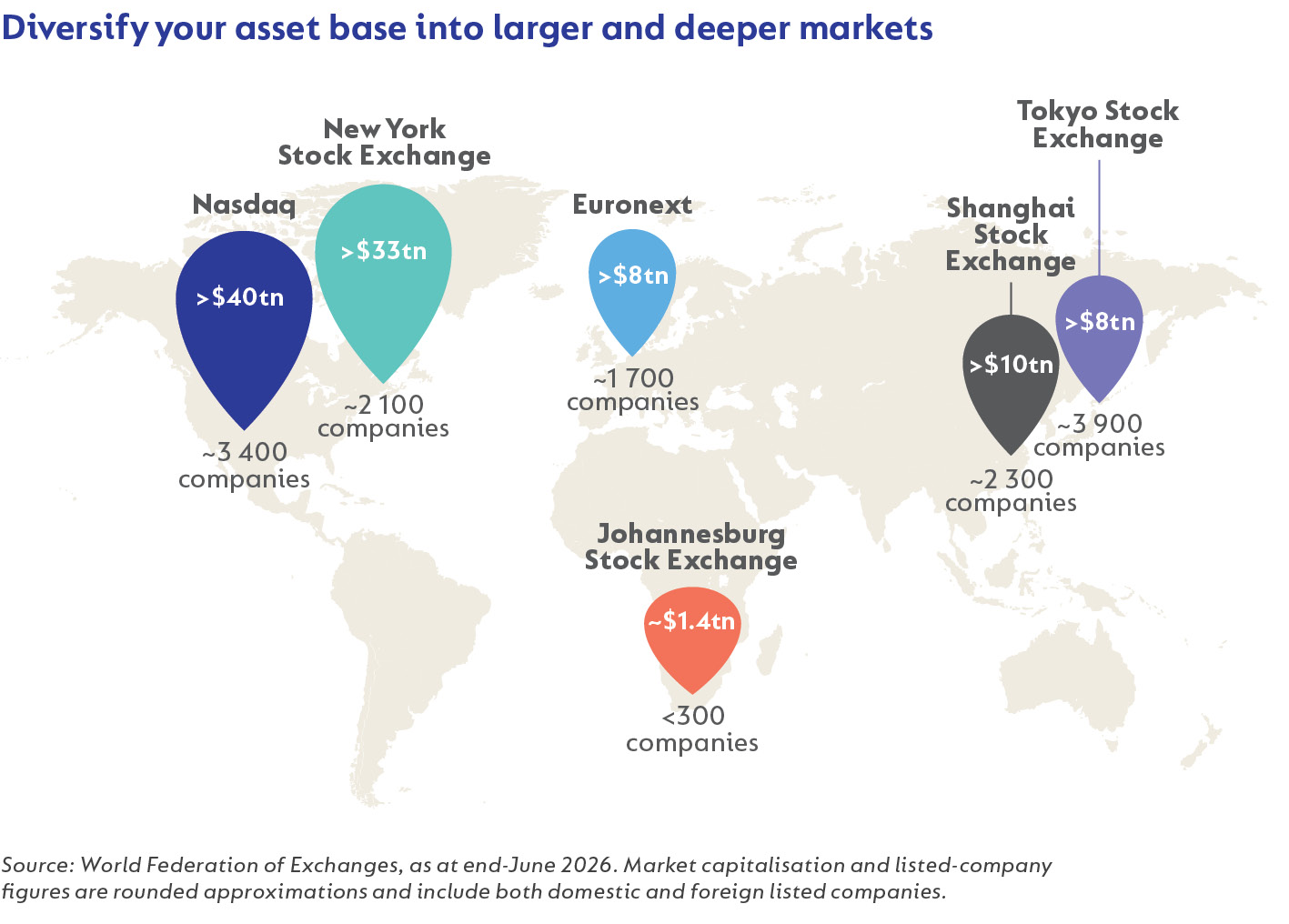
South Africa represents a relatively small portion of the global investment universe. Investing offshore gives you access to a far broader range of companies, industries, and economies than those available on the JSE. This includes global sectors such as artificial intelligence, technology, healthcare, and advanced manufacturing, which may be underrepresented or absent locally.
The sheer magnitude of investment opportunities outside South Africa is evident in the combined market capitalisation of the world’s top five exchanges and number of listed companies, which are multiples of those of the JSE.
Add a powerful layer of diversification to your portfolio
Diversification is another important reason for offshore investing in South Africa. Local and global investments do not always perform the same way at the same time, which means offshore exposure can help balance your portfolio and make it more resilient over the long term.
Investing offshore also gives you an opportunity to diversify across currencies. Making offshore investments directly in foreign currency – such as dollars, pounds, or euros – can be a practical approach if you are planning for a specific goal abroad. This might include sending a child to study overseas or planning for a possible move one day.
In these situations, holding investments in the same currency you may eventually need can provide greater certainty over time. It reduces the risk of exchange rate movements working against you at the wrong moment and helps ensure your savings retain their intended spending power when you need them.
How to invest offshore from South Africa
Before choosing the best offshore investments for South Africans, it’s important to consider the different ways in which you can invest offshore. The route you choose depends on your goals.
| Invest in rand-denominated offshore funds |
This route allows you to invest in international markets without physically moving money offshore. You invest in rands from South Africa, but the underlying portfolio is invested in offshore assets such as global shares, bonds, and other international investments. This means you can gain exposure to global markets and foreign currencies while still investing locally. The fund manager takes care of the offshore investing process on your behalf, including currency conversion and access to international markets. With rand-denominated offshore funds, you WON’T need to: - Open a foreign bank account |
| Invest offshore in a foreign currency |
With this route, you convert your rands into a foreign currency, such as US dollars, and you physically externalise your money. This gives you exposure not only to international investments, but also to offshore jurisdictions and foreign currencies. With this approach, you WILL need to: - Use your South African Reserve Bank offshore investing allowance Some investors prefer this route because it offers an additional layer of jurisdictional diversification, with assets held outside South Africa. The right approach depends on your goals and personal circumstances. |
What is the offshore allowance in South Africa?
South Africans are allowed to invest a certain amount offshore each year under rules set by the South African Reserve Bank (SARB). These limits are known as SARB offshore allowances.
There are two main allowances available to individuals:
| Allowance | Annual limit | Tax clearance required? |
|---|---|---|
| Single Discretionary Allowance (SDA): The amount South Africans can transfer offshore each calendar year without tax clearance. This can be used for offshore investing, overseas travel, and certain other foreign payments. |
R2 million | No |
| Foreign Capital Allowance (FCA): An additional offshore transfer allowance available once the SDA has been used. Tax clearance is generally required before these funds can be transferred. |
R10 million | Yes |
Some important things to note
These SARB offshore allowances apply per calendar year and do not roll over if unused. Plus, they only apply when you physically externalise money from South Africa. If you invest through rand-denominated offshore funds, no offshore allowance is used because your investment remains locally domiciled, even though the underlying assets are invested in global markets.
Why invest offshore with Coronation?
We have been investing offshore, through multiple market cycles, for close to 30 years. Our investment team conducts global research to find investments that offer value over the long term.
Our broad coverage of global markets gives investors access to a broader and more diverse opportunity set, which can enhance long-term return potential. Investing across regions, sectors, and asset classes also helps reduce overall portfolio risk through diversification.

How to invest offshore from South Africa
We offer you several ways to diversify your portfolio by investing offshore, depending on whether you prefer to invest in rands or directly in foreign currency.
Our rand-denominated international funds allow you to invest in global markets while investing locally in rands. These funds invest into Coronation’s offshore portfolios and offer exposure to international assets without requiring you to move money offshore yourself.
For investors who want to physically externalise their assets, we also offer funds denominated in currencies such as US dollars. This route allows you to hold assets offshore and access additional jurisdictional diversification.
Flexible minimum investment amounts
Depending on the investment route you choose, Coronation offers accessible minimum investment amounts:
- A minimum of R500 per month for rand-denominated offshore feeder funds
- A minimum lump sum of $500, €500 or £500 for foreign currency offshore funds
What’s the right offshore investing strategy for you?
As with any investment, choosing the right offshore allocation and investment structure depends on your financial goals, time horizon, and future spending needs. A qualified financial adviser can help you determine the most appropriate way to invest part of your portfolio in global funds and/or use your offshore allowance in South Africa.
Frequently asked questions (FAQ)
Why should South Africans consider investing offshore?Investing offshore can help South Africans diversify beyond the local market, gain exposure to global industries and companies, and build wealth in foreign currencies. It can also help protect purchasing power over time, as many everyday expenses are influenced by global prices and currency movements. |
What is the offshore allowance in South Africa?Yes. Tax-free investments offer flexibility, and you can withdraw your money whenever you choose. However, withdrawals do not reset your contribution limits, so any amount withdrawn will still count towards your lifetime allowance. |
Do I need tax clearance to invest offshore?Not always. Investments made within the R2 million Single Discretionary Allowance generally do not require tax clearance. Amounts invested above this threshold through the Foreign Capital Allowance require SARS tax clearance. |
What is the difference between rand-denominated offshore funds and direct offshore investments?Rand-denominated international funds allow you to invest in offshore markets while investing locally in rands. A direct offshore investment involves converting your money into foreign currency and physically holding assets offshore. |
Must I pay tax on offshore investments South Africa?Capital gains tax (CGT) applies if you sell units held as capital assets. Income tax applies if the units were held for speculation. Coronation funds are structured as roll-up funds, so income is reinvested (not distributed). |
Can I invest offshore through a retirement annuity?Yes. South African retirement products are allowed to invest up th 45% of their assets offshore within Regulation 28 limits. This gives investors meaningful international exposure within retirement savings products such as retirement annuities. |
What happens to my offshore investment if the rand strengthens?With offshore investing in South Africa, if the rand strengthens against foreign currencies, the rand value of your offshore investment may decrease, even if the underlying offshore assets perform well. Currency movements can therefore either enhance or reduce offshore returns in rand terms over shorter periods. |



Explore Investment Insights on the global economy, markets and topics related to our business.

Subscribe to our Corospondent newsletter